English
 Español
 Deutsch
 Nederlands
 Français
 Svenska
 Italiano
The Ultimate Buyer's Guide to Buying Property on the Costa Blanca
More than 200 kilometres of Spain's Mediterranean coast, from Dénia in the north to Pilar de la Horadada in the south — town by town, for every type of buyer.
Villajoyosa
De vastgoedmarkt van Villajoyosa, de kleurrijke kustboulevard en de authentieke mediterrane levensstijl, belicht door lokale experts en zorgvuldig geselecteerde woningen.
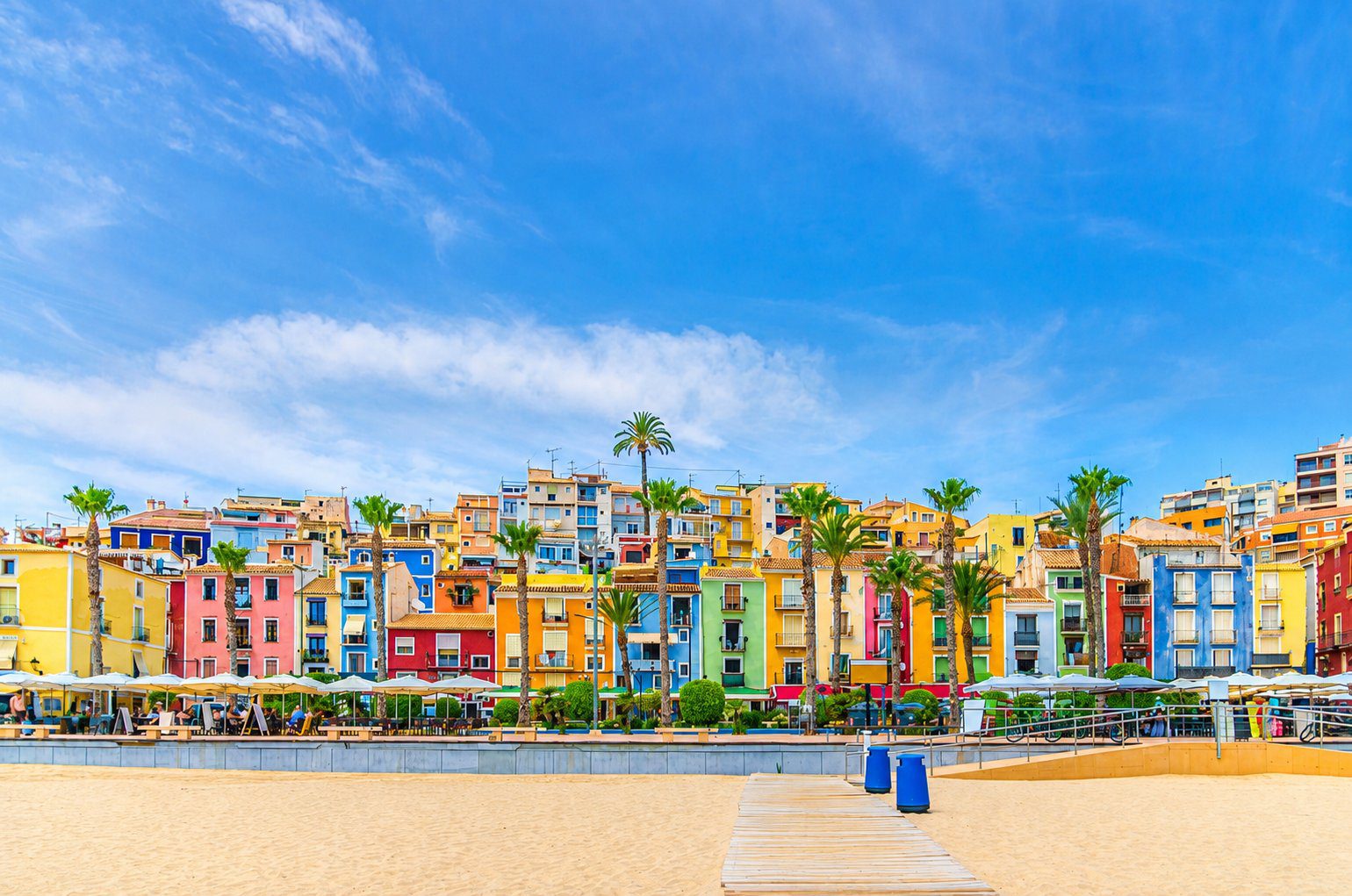
Villajoyosa is een van de meest karaktervolle kustplaatsen aan de Costa Blanca, beroemd om zijn kleurrijke boulevard, gouden stranden en rijke maritieme erfgoed. De plaats combineert authentieke Spaanse charme met een groeiende luxevastgoedmarkt en biedt alles van appartementen aan het strand en traditionele woningen in de Oude Stad tot moderne villa's met uitzicht over de Middellandse Zee. Dankzij de ontspannen sfeer het hele jaar door, de bloeiende culinaire scene en de uitstekende ligging tussen Benidorm en Alicante blijft Villajoyosa permanente bewoners, kopers van een tweede woning en investeerders aantrekken die op zoek zijn naar een authentieke levensstijl aan de kust.
Villajoyosa has over three kilometres of coastline and 13 named beaches and coves running from El Racó de Conill in the north to Playa El Xarco in the south. Playa Centro, a roughly 1km sweep of sand right by the Old Town and TRAM stop, is the main family beach with full facilities; Platja del Paradís (El Paraíso) is a quieter 1km sand-and-pebble stretch with summer chiringuitos; and Racó de Conill, a secluded 160m cove reached on foot from a small car park, is one of the area's recognised naturist beaches.
Coastal walking trails link Villajoyosa's beaches and coves, with mountain views inland toward the Puig Campana/Sierra Cortina range shared with neighbouring Finestrat — Puig Campana Golf, a 9-hole course, sits in countryside spanning the Finestrat/Villajoyosa boundary. The town's working-harbour character extends to its nature offer: early mornings at the fishing port are, per local accounts, one of the best ways to see the catch come in.
Villajoyosa's food identity is built on two pillars: fresh harbour seafood — the fishing port remains active, with nearby restaurants serving the daily catch — and chocolate. Chocolates Valor, founded in 1881 by Valeriano López Lloret, still operates its modern 22,000m² factory in the town (built 1995, 300+ employees) and runs the Valor Chocolate Museum, created in 1998 and formally recognised by the Generalitat Valenciana in 2008 as the Valencian Chocolate Museum, with free guided tours and tastings. Chocolate-making in the town traces back to the 17th century via its maritime trade routes with the Americas, with the first recorded chocolatier in 1810 and as many as 29 chocolate businesses operating by 1937. No Michelin-recognised restaurant is listed for Villajoyosa in the MICHELIN Guide España 2026; the nearest starred kitchen is El Xato in La Nucía.
The colourful Old Town facades are Villajoyosa's signature leisure/culture draw — a tradition most commonly explained as fishermen painting homes in distinct colours to spot them from the sea, with some accounts adding that coloured fabrics were once used to signal family news (white for a birth, black for a death); the precise origin isn't definitively settled and several versions of the story circulate, but the Old Town's colour-and-Renaissance-wall streetscape is a recognised cultural asset and a draw in its own right. The annual Moros i Cristians festival (late July) and the town's Gothic Church of the Assumption, with its Baroque altarpiece, add further cultural weight beyond the beaches.
The TRAM d'Alacant station sits in the heart of the Old Town, a short walk from the main beach, on the line linking Alicante to Benidorm via El Campello and Terra Mítica — trams run roughly every 30 minutes, making Villajoyosa one of the more car-optional coastal bases on this stretch of the Costa Blanca. Beyond the tram, day-to-day outdoor living centres on the working harbour, the beach promenade, and coastal walking between the town's many small coves.
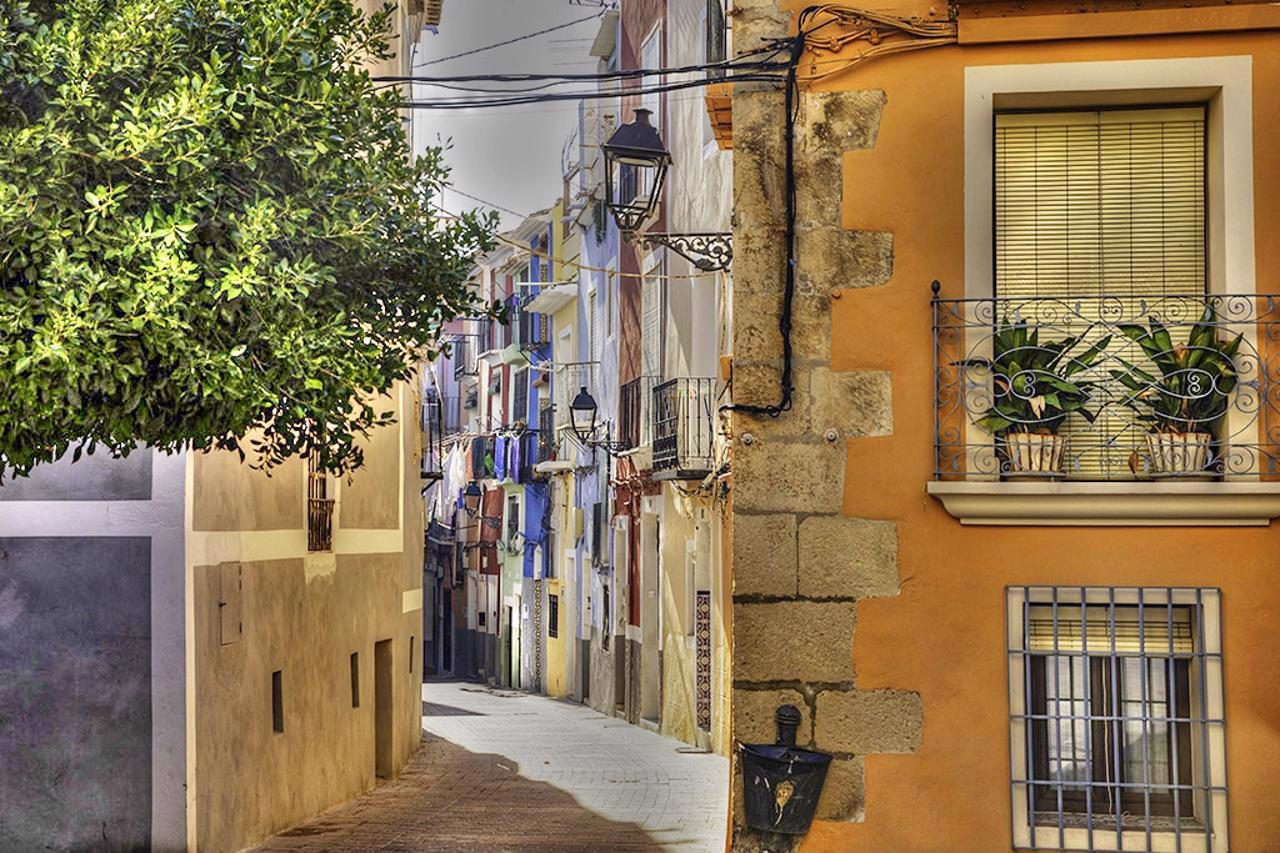
Villajoyosa verstevigt zijn positie als een van de meest gewilde residentiële bestemmingen aan de Costa Blanca en profiteert van een toenemende binnenlandse en internationale vraag. In 2026 bedragen de gemiddelde vraagprijzen ongeveer €3,150/m², wat wijst op aanhoudende groei in zowel de bestaande bouw als de nieuwbouw. Hoewel de plaats een authentiekere sfeer biedt dan sommige naburige badplaatsen, zijn de prijzen er gestaag gestegen doordat kopers op zoek zijn naar wonen aan de kust met voorzieningen die het hele jaar door beschikbaar zijn.
De vastgoedwaarden verschillen per gebied binnen de gemeente. De historische Oude Stad en de boulevard aan zee behoren nog steeds tot de meest gewilde locaties, waarbij kleurrijke woningen aan zee en moderne appartementen op veel vraag kunnen rekenen. Woongebieden zoals Montíboli en Paraíso zijn synoniem geworden met luxueus wonen en bieden moderne villa's, exclusieve ontwikkelingen en panoramische uitzichten over de Middellandse Zee. Verder landinwaarts kunnen kopers nog steeds uitstekende waarde vinden in gevestigde woonwijken en gezinswoningen.
Appartementen vormen een aanzienlijk deel van de woningmarkt, vooral langs de kust, terwijl vrijstaande villa's het hogere marktsegment blijven domineren. Moderne woningen met zeezicht, privézwembaden en directe toegang tot het strand behoren regelmatig tot de hoogst gewaardeerde objecten, met name in de exclusieve omgeving van Montíboli.
Internationale kopers spelen een steeds belangrijkere rol op de markt. Kopers uit België, Nederland, Duitsland, het Verenigd Koninkrijk en Scandinavië sluiten zich aan bij een sterke binnenlandse kopersgroep. In combinatie met uitstekende vervoersverbindingen, prachtige stranden, een werkende vissershaven en een ontspannen mediterrane levensstijl biedt Villajoyosa een aantrekkelijke balans tussen authenticiteit, investeringspotentieel en vermogensgroei op lange termijn.
| Type | Average | YoY |
|---|---|---|
| apartments | EUR 3,250/m² | +9.5% |
| houses | EUR 2,950/m² | +9.5% |
| villas | EUR 3,950/m² | +9.5% |
It suits retirees who want an authentic, year-round Spanish town over a purpose-built resort — a working harbour, a large resident population (around 37,000), full local amenities, and a TRAM stop for car-free trips along the coast. The trade-off against Benidorm or Altea: fewer international retiree services and a less English-speaking-oriented everyday infrastructure, though this was not independently benchmarked for this draft.
Yes, particularly for buyers who want an authentic, working Spanish coastal town with genuine year-round community life, over three kilometres of beaches, and TRAM access to Benidorm and Alicante — rather than a resort-style urbanisation.
Two things above all: its candy-coloured Old Town facades, traditionally explained as a way for fishermen to spot their homes from the sea, and Chocolates Valor, the chocolate maker founded here in 1881 whose museum and factory tours are a major visitor draw.
Less so than Benidorm, its neighbour. Villajoyosa is explicitly positioned by residents and guides as a working town — an active fishing port and a large permanent population — that also happens to have colourful streets and good beaches, rather than a purpose-built resort.
It varies sharply by district and by which price snapshot is used: one recent Idealista pull shows a town-wide average of €3,539/m² (May 2026); a related pull breaks the market down further, from €1,855/m² in El Secanet–Hacienda del Sol to €3,972/m² on the Platja Vila Joiosa beachfront.
Vul onderstaand formulier in om van start te gaan.