English
 Español
 Deutsch
 Nederlands
 Français
 Svenska
 Italiano
The Ultimate Buyer's Guide to Buying Property on the Costa Blanca
More than 200 kilometres of Spain's Mediterranean coast, from Dénia in the north to Pilar de la Horadada in the south — town by town, for every type of buyer.
Villajoyosa
Le marché immobilier de Villajoyosa, son front de mer coloré et son authentique art de vivre méditerranéen à travers l’expertise locale et une sélection rigoureuse de propriétés.
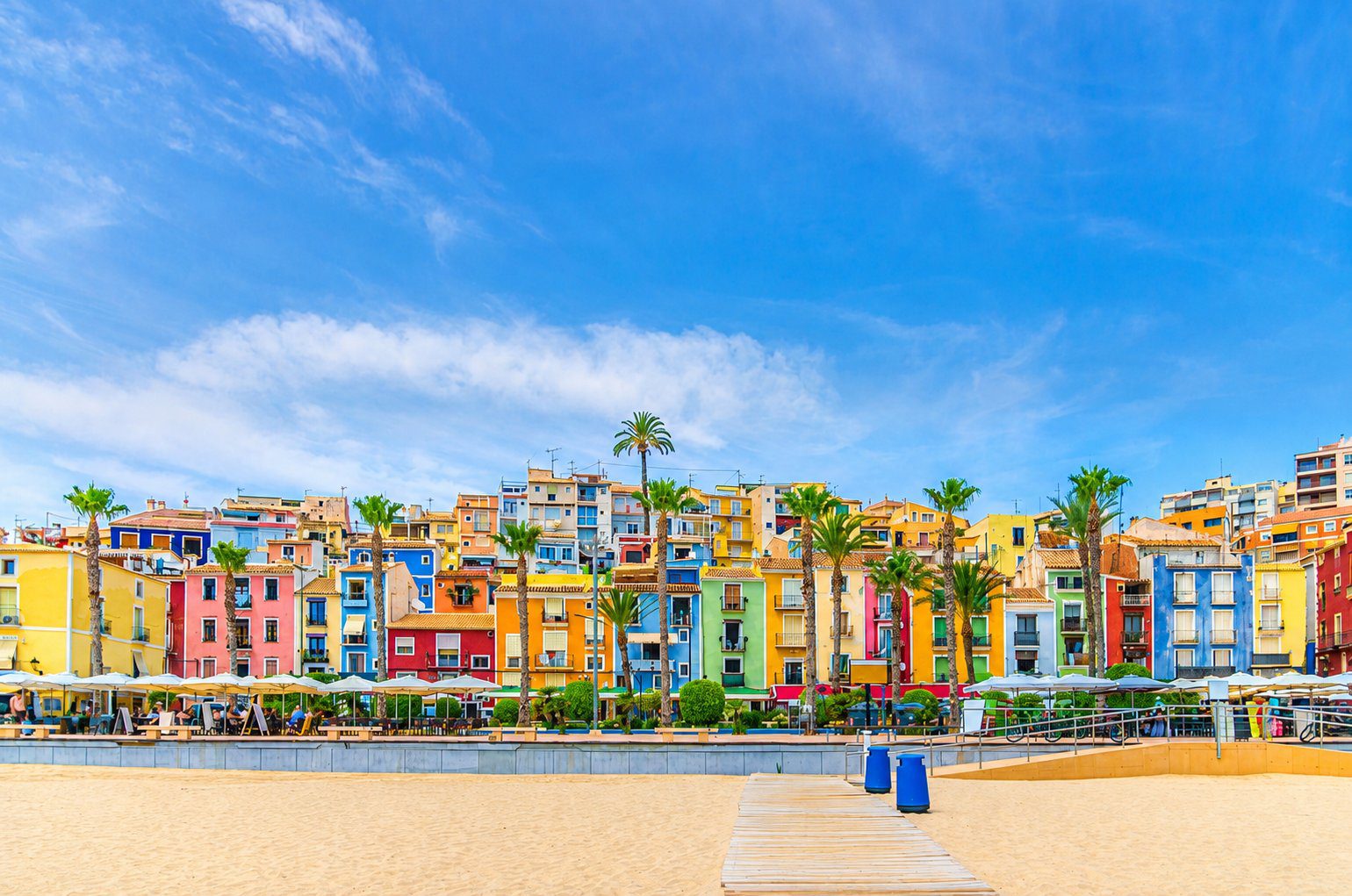
Villajoyosa est l’une des villes côtières les plus authentiques de la Costa Blanca, célèbre pour son front de mer coloré, ses plages dorées et son riche patrimoine maritime. Alliant le charme espagnol authentique à un marché immobilier de luxe en plein essor, la ville propose aussi bien des appartements en bord de mer et des maisons traditionnelles dans la vieille ville que des villas contemporaines surplombant la Méditerranée. Avec son atmosphère paisible toute l’année, sa scène gastronomique dynamique et son emplacement privilégié entre Benidorm et Alicante, Villajoyosa continue d’attirer les résidents permanents, les acquéreurs de résidences secondaires et les investisseurs à la recherche d’un art de vivre authentique sur la côte.
Villajoyosa has over three kilometres of coastline and 13 named beaches and coves running from El Racó de Conill in the north to Playa El Xarco in the south. Playa Centro, a roughly 1km sweep of sand right by the Old Town and TRAM stop, is the main family beach with full facilities; Platja del Paradís (El Paraíso) is a quieter 1km sand-and-pebble stretch with summer chiringuitos; and Racó de Conill, a secluded 160m cove reached on foot from a small car park, is one of the area's recognised naturist beaches.
Coastal walking trails link Villajoyosa's beaches and coves, with mountain views inland toward the Puig Campana/Sierra Cortina range shared with neighbouring Finestrat — Puig Campana Golf, a 9-hole course, sits in countryside spanning the Finestrat/Villajoyosa boundary. The town's working-harbour character extends to its nature offer: early mornings at the fishing port are, per local accounts, one of the best ways to see the catch come in.
Villajoyosa's food identity is built on two pillars: fresh harbour seafood — the fishing port remains active, with nearby restaurants serving the daily catch — and chocolate. Chocolates Valor, founded in 1881 by Valeriano López Lloret, still operates its modern 22,000m² factory in the town (built 1995, 300+ employees) and runs the Valor Chocolate Museum, created in 1998 and formally recognised by the Generalitat Valenciana in 2008 as the Valencian Chocolate Museum, with free guided tours and tastings. Chocolate-making in the town traces back to the 17th century via its maritime trade routes with the Americas, with the first recorded chocolatier in 1810 and as many as 29 chocolate businesses operating by 1937. No Michelin-recognised restaurant is listed for Villajoyosa in the MICHELIN Guide España 2026; the nearest starred kitchen is El Xato in La Nucía.
The colourful Old Town facades are Villajoyosa's signature leisure/culture draw — a tradition most commonly explained as fishermen painting homes in distinct colours to spot them from the sea, with some accounts adding that coloured fabrics were once used to signal family news (white for a birth, black for a death); the precise origin isn't definitively settled and several versions of the story circulate, but the Old Town's colour-and-Renaissance-wall streetscape is a recognised cultural asset and a draw in its own right. The annual Moros i Cristians festival (late July) and the town's Gothic Church of the Assumption, with its Baroque altarpiece, add further cultural weight beyond the beaches.
The TRAM d'Alacant station sits in the heart of the Old Town, a short walk from the main beach, on the line linking Alicante to Benidorm via El Campello and Terra Mítica — trams run roughly every 30 minutes, making Villajoyosa one of the more car-optional coastal bases on this stretch of the Costa Blanca. Beyond the tram, day-to-day outdoor living centres on the working harbour, the beach promenade, and coastal walking between the town's many small coves.
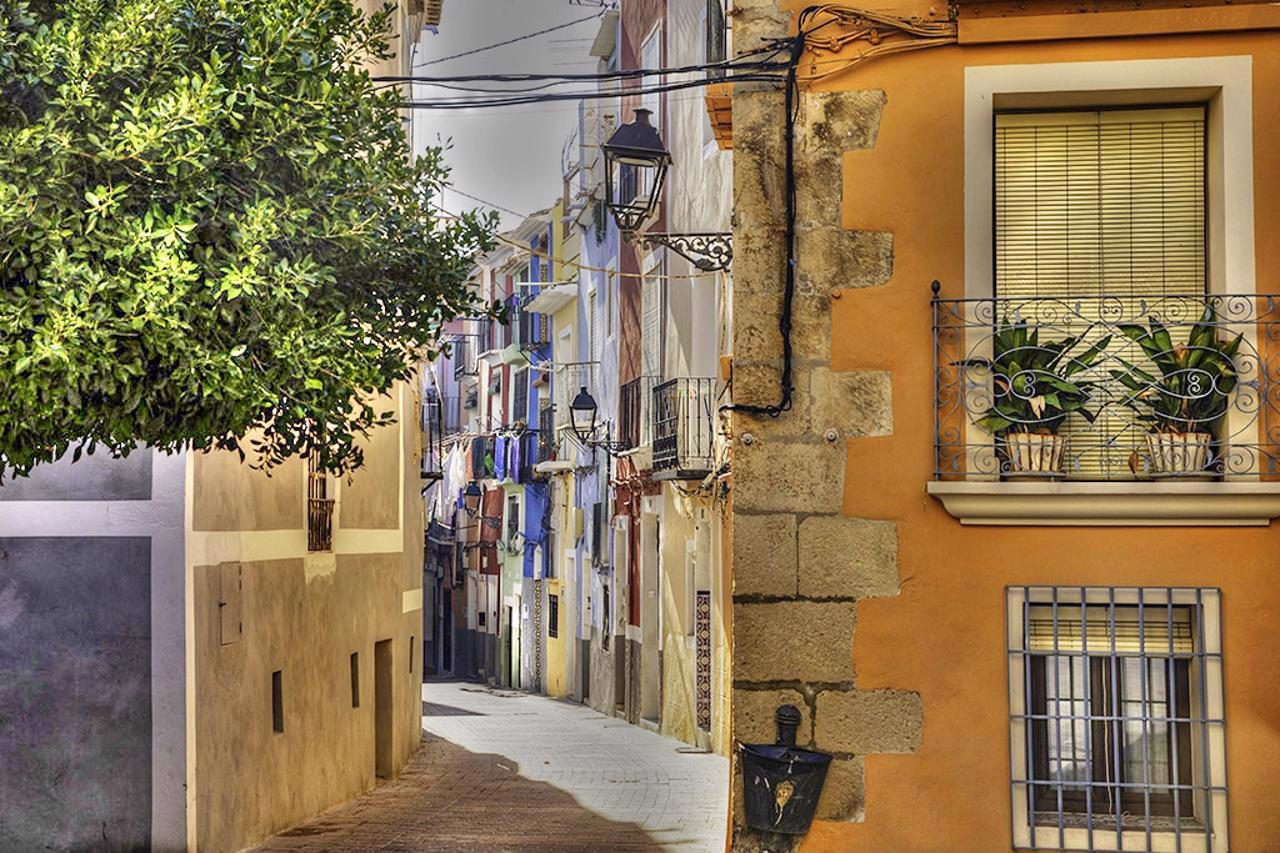
Villajoyosa continue de renforcer sa position parmi les destinations résidentielles les plus prisées de la Costa Blanca, portée par une demande nationale et internationale croissante. En 2026, les prix moyens affichés s’élèvent à environ 3 150 €/m², reflétant une croissance continue tant sur le marché de la revente que sur celui des constructions neuves. Tout en offrant une atmosphère plus authentique que certaines stations voisines, la ville connaît une appréciation constante des prix, les acquéreurs recherchant un cadre de vie côtier avec des commodités accessibles toute l’année.
Les valeurs immobilières varient selon les quartiers de la commune. La vieille ville historique et la promenade du front de mer restent parmi les emplacements les plus recherchés, les propriétés colorées en bord de mer et les appartements modernes bénéficiant d’une forte demande. Les quartiers résidentiels tels que Montíboli et Paraíso sont devenus synonymes de vie luxueuse, avec leurs villas contemporaines, leurs résidences exclusives et leurs vues panoramiques sur la Méditerranée. Plus à l’intérieur des terres, les acquéreurs peuvent encore trouver d’excellentes opportunités dans des quartiers résidentiels établis et des maisons familiales.
Les appartements représentent une part importante du marché immobilier, notamment le long du littoral, tandis que les villas individuelles continuent de dominer le segment haut de gamme. Les maisons modernes offrant une vue sur la mer, une piscine privée et un accès direct à la plage atteignent régulièrement les valeurs les plus élevées, en particulier dans le secteur exclusif de Montíboli.
Les acquéreurs internationaux continuent de jouer un rôle de plus en plus important sur le marché, avec des acheteurs venus de Belgique, des Pays-Bas, d’Allemagne, du Royaume-Uni et de Scandinavie, qui rejoignent une solide base d’acquéreurs nationaux. Grâce à ses excellentes liaisons de transport, ses magnifiques plages, son port de pêche en activité et son art de vivre méditerranéen paisible, Villajoyosa offre un équilibre séduisant entre authenticité, potentiel d’investissement et croissance du capital à long terme.
| Type | Average | YoY |
|---|---|---|
| apartments | EUR 3,250/m² | +9.5% |
| houses | EUR 2,950/m² | +9.5% |
| villas | EUR 3,950/m² | +9.5% |
It suits retirees who want an authentic, year-round Spanish town over a purpose-built resort — a working harbour, a large resident population (around 37,000), full local amenities, and a TRAM stop for car-free trips along the coast. The trade-off against Benidorm or Altea: fewer international retiree services and a less English-speaking-oriented everyday infrastructure, though this was not independently benchmarked for this draft.
Yes, particularly for buyers who want an authentic, working Spanish coastal town with genuine year-round community life, over three kilometres of beaches, and TRAM access to Benidorm and Alicante — rather than a resort-style urbanisation.
Two things above all: its candy-coloured Old Town facades, traditionally explained as a way for fishermen to spot their homes from the sea, and Chocolates Valor, the chocolate maker founded here in 1881 whose museum and factory tours are a major visitor draw.
Less so than Benidorm, its neighbour. Villajoyosa is explicitly positioned by residents and guides as a working town — an active fishing port and a large permanent population — that also happens to have colourful streets and good beaches, rather than a purpose-built resort.
It varies sharply by district and by which price snapshot is used: one recent Idealista pull shows a town-wide average of €3,539/m² (May 2026); a related pull breaks the market down further, from €1,855/m² in El Secanet–Hacienda del Sol to €3,972/m² on the Platja Vila Joiosa beachfront.
Veuillez remplir le formulaire ci-dessous pour commencer.