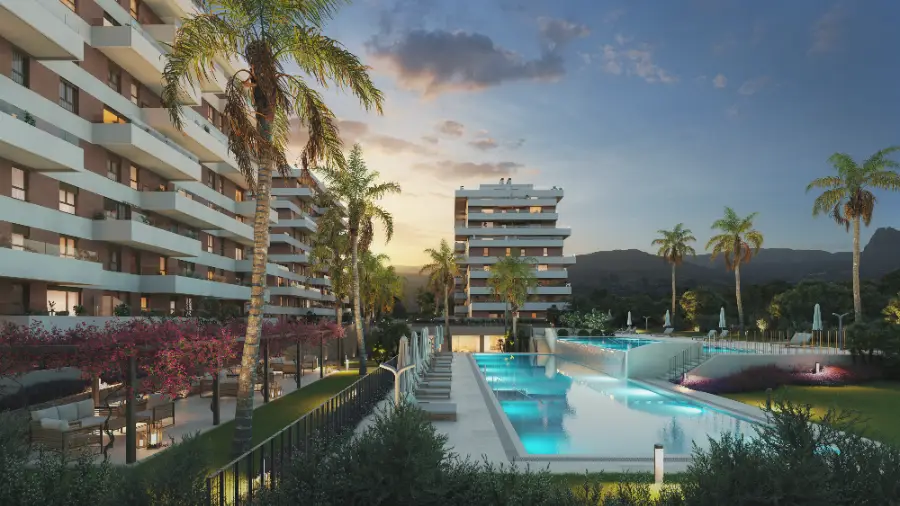
Penthouse
Penthouse Orizonne 5
321
EUR 740,000

Villajoyosa
A genuine Spanish working town, not a resort: over three kilometres of beaches, a 145-year-old chocolate industry, a candy-coloured historic centre, and a TRAM stop in the heart of the Old Town
Villajoyosa (La Vila Joiosa) is the historic and administrative capital of the Marina Baixa region, with a population of around 37,449 across 20.45km2 - noticeably larger and more year-round than most of its Costa Blanca North neighbours . Unlike the resort towns further along the coast, it markets itself candidly as a working town: a still-active fishing port, a 145-year-old chocolate industry, and an Old Town that earns its living from residents as much as from tourism . Its best-known feature is visual - a seafront of brightly painted houses in the historic quarter, traditionally explained as a way for fishermen to identify their own homes from out at sea . The Moros i Cristians festival held each July, commemorating a repelled Berber pirate landing, points to a longer history of coastal defence than the town's cheerful colours might suggest . For buyers, this translates into a market built around beachfront and Old Town apartments rather than gated villa urbanisations, with a TRAM Metropolitano d'Alacant stop in the town centre giving car-free access along the coast .
Villajoyosa has over three kilometres of coastline and 13 named beaches and coves running from El Raco de Conill in the north to Playa El Xarco in the south . Playa Centro, a roughly 1km sweep of sand right by the Old Town and TRAM stop, is the main family beach with full facilities; Platja del Paradis (El Paraiso) is a quieter 1km sand-and-pebble stretch with summer chiringuitos; and Raco de Conill, a secluded 160m cove reached on foot from a small car park, is one of the area's recognised naturist beaches .
Coastal walking trails link Villajoyosa's beaches and coves, with mountain views inland toward the Puig Campana/Sierra Cortina range shared with neighbouring Finestrat - Puig Campana Golf, a 9-hole course, sits in countryside spanning the Finestrat/Villajoyosa boundary . The town's working-harbour character extends to its nature offer: early mornings at the fishing port are, per local accounts, one of the best ways to see the catch come in .
Villajoyosa's food identity is built on two pillars: fresh harbour seafood - the fishing port remains active, with nearby restaurants serving the daily catch - and chocolate. Chocolates Valor, founded in 1881 by Valeriano Lopez Lloret, still operates its modern 22,000m2 factory in the town (built 1995, 300+ employees) and runs the Valor Chocolate Museum, created in 1998 and formally recognised by the Generalitat Valenciana in 2008 as the Valencian Chocolate Museum, with free guided tours and tastings . Chocolate-making in the town traces back to the 17th century via its maritime trade routes with the Americas, with the first recorded chocolatier in 1810 and as many as 29 chocolate businesses operating by 1937 . No Michelin-recognised restaurant is listed for Villajoyosa in the MICHELIN Guide Espana 2026 ; the nearest starred kitchen is El Xato in La Nucia.
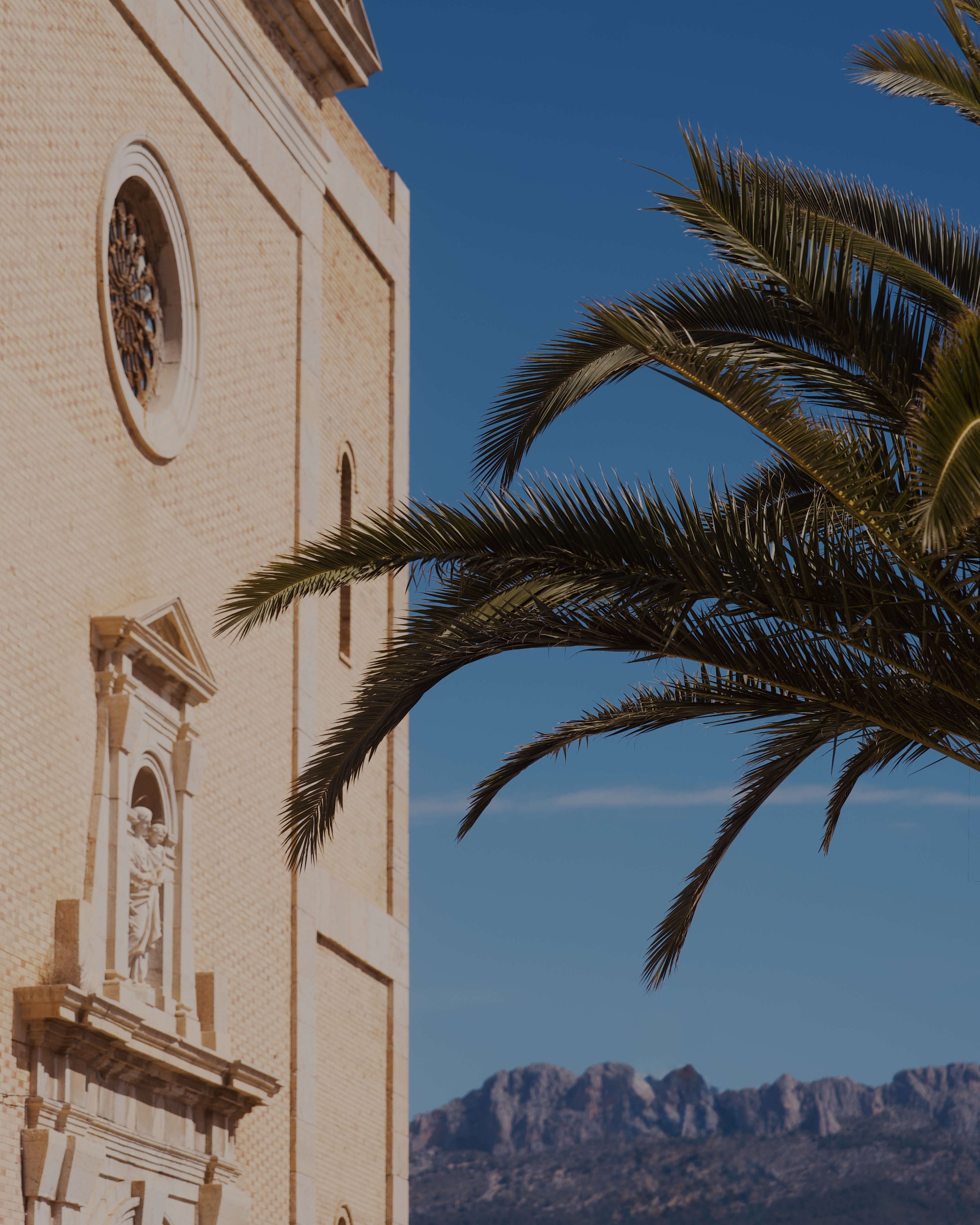
The colourful Old Town facades are Villajoyosa's signature leisure/culture draw - a tradition most commonly explained as fishermen painting homes in distinct colours to spot them from the sea, with some accounts adding that coloured fabrics were once used to signal family news (white for a birth, black for a death); the precise origin isn't definitively settled and several versions of the story circulate, but the Old Town's colour-and-Renaissance-wall streetscape is a recognised cultural asset and a draw in its own right . The annual Moros i Cristians festival (late July) and the town's Gothic Church of the Assumption, with its Baroque altarpiece, add further cultural weight beyond the beaches .
The TRAM d'Alacant station sits in the heart of the Old Town, a short walk from the main beach, on the line linking Alicante to Benidorm via El Campello and Terra Mitica - trams run roughly every 30 minutes, making Villajoyosa one of the more car-optional coastal bases on this stretch of the Costa Blanca . Beyond the tram, day-to-day outdoor living centres on the working harbour, the beach promenade, and coastal walking between the town's many small coves.
Idealista price-report data shows some volatility in Villajoyosa's recent figures: the most recent snapshot available for this draft put the average at 3,539/m2 in May 2026, up 3.5% month-on-month, 10.6% against February 2026 and 31.6% year-on-year A related, apparently slightly earlier data pull put the overall average at 2,782/m2, with flats and apartments the pricier typology at 2,912/m2 against 2,286/m2 for houses and chalets . By district, El Secanet-Hacienda del Sol is the cheapest area at 1,855/m2, while Platja Vila Joiosa (the beachfront) is the most expensive at 3,972/m2 . Average rent across the town is 14.2/m2 per month .
It suits retirees who want an authentic, year-round Spanish town over a purpose-built resort - a working harbour, a large resident population (around 37,000), full local amenities, and a TRAM stop for car-free trips along the coast. The trade-off against Benidorm or Altea: fewer international retiree services and a less English-speaking-oriented everyday infrastructure, though this was not independently benchmarked for this draft.
Yes, particularly for buyers who want an authentic, working Spanish coastal town with genuine year-round community life, over three kilometres of beaches, and TRAM access to Benidorm and Alicante - rather than a resort-style urbanisation .
Two things above all: its candy-coloured Old Town facades, traditionally explained as a way for fishermen to spot their homes from the sea, and Chocolates Valor, the chocolate maker founded here in 1881 whose museum and factory tours are a major visitor draw .
Less so than Benidorm, its neighbour. Villajoyosa is explicitly positioned by residents and guides as a working town - an active fishing port and a large permanent population - that also happens to have colourful streets and good beaches, rather than a purpose-built resort .
It varies sharply by district and by which price snapshot is used: one recent Idealista pull shows a town-wide average of 3,539/m2 (May 2026); a related pull breaks the market down further, from 1,855/m2 in El Secanet-Hacienda del Sol to 3,972/m2 on the Platja Vila Joiosa beachfront .
We would love to hear from you. Please fill out the form below to get started.